


You can, and almost nobody should. A bra under a bralette adds two bands, two sets of straps and a visible edge, and it solves none of the four problems that make people reach for it. Each of those problems has a better answer, and three of them are sizing rather than layering.
It is a question worth taking seriously, because the people asking it are usually being let down by a bralette they already own. The useful thing is not the yes or no. It is working out which of the four reasons is yours.
Why You Are Asking
There are only four. Support — the bralette does not hold you where you want to be held. Shape — it flattens or spreads rather than lifting. Show-through — you can see more than you meant to under a thin top. Or sheer layering — the bralette itself is see-through and you want something under it.
Only the last of those is genuinely a layering problem. The other three are telling you something about fit or construction, and adding a second garment on top of a first one that does not fit will not fix any of them.
The Short Answer, By Reason
| Your reason | Does a bra underneath work | What actually fixes it |
|---|---|---|
| Not enough support | No — two loose bands are not one firm one | A firmer band, or a soft-wire construction |
| Wrong shape | No — the outer layer still sits where it sits | A cup with structure: moulded, seamed or 3D-cut |
| Show-through | Sometimes, and it always shows at the edges | Covers, or a lined cup |
| Bralette is sheer and worn as outerwear | Yes, this is the one real case | A smooth seamless bra or a slip underneath |
Support is worth spelling out, because it is the most common reason and the one where the instinct is most wrong. Support in an unwired garment comes from the band, not the cups — the band takes most of the load, and cups only direct it. Two bands stacked on top of each other do not add up. They sit at slightly different heights, each one loose, and the result is less stable than one band that fits.
What We Would Change First
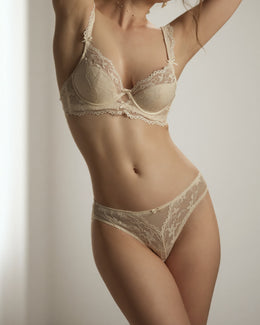
Our own line splits at exactly this point, and the split is the answer to the question. Pieces like the Bare Minimum Silk Set have no wire, no lining and no padding, and are sized S to XL — the top and the underwear are even sized separately, because a body that is a small on top is often not a small underneath. That set is honest about what it is. It will not hold you the way a structured cup does, and no second garment underneath will change that.
Then there are pieces built for the opposite job. The Soft Landing Lace Set uses a memory soft-wire that takes your shape rather than imposing one, and the Plain Sight Sheer Set puts a U-shaped memory wire under lace-lined cups so it lifts without a rigid underwire. If the reason you want a bra under your bralette is support, the honest fix is one of these instead — one garment, one band, doing the whole job.
The Show-Through Case
This is the only reason where layering is a reasonable instinct, and it is still not the best answer. A bra under a bralette gives you a cup edge that shows through anything thin, which trades one visible problem for another.
Covers do the job with nothing to show. Something like the Breathing Room Covers sits at a quarter of a centimetre thick and disappears under a bralette, which no bra cup will do. If you would rather not use covers, a lined cup is the built-in version of the same fix — lined is not the same as padded, and a whisper-thin lining changes what shows without changing your shape.
When Layering Is Right
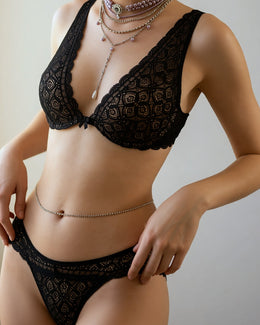
If the bralette is the visible layer — worn under an open shirt, over a slip, or as part of the outfit rather than under it — then yes, wear something underneath. In that case the bralette is functioning as clothing, and what goes under it is a normal question.
Two rules make it work. Match the neckline, so nothing peeks above the lace. And go smooth: a seamless or moulded cup under a lace bralette reads as skin, while a second lace layer reads as two bras. A structured piece like the After Hours Bustier Set is the other route entirely — it has the boning and the seven-hook back to do the supporting job on its own, so nothing needs to go under it.
If you are still deciding between the two categories, we set out the difference in bralette versus bra, and what each cup construction actually does in bra cup construction explained. The full range is in lingerie sets.
FAQ
Can you wear a bra under a bralette?
Physically yes, but it rarely helps. Two bands sitting at different heights are less stable than one band that fits, and the cup edge of the bra shows through thin fabric. The exception is when the bralette is worn as a visible layer, where a smooth seamless bra underneath makes sense.
Do bralettes give enough support?
It depends on the band and the cup, not on the absence of wire. A firm band carries most of the load, and constructions such as soft-wire or a 3D-cut cup add shape. An unlined triangle bralette is designed for comfort rather than lift, and that is a choice, not a fault.
How do you stop show-through under a bralette?
Use covers or a lined cup. Silicone covers around a quarter of a centimetre thick disappear under fabric where a second bra cup would create a visible edge. Lined is not padded — a whisper-thin lining changes what shows without changing your shape.
What do you wear under a sheer bralette?
Something smooth and matched to the neckline. A seamless or moulded cup reads as skin under lace, while a second lace layer reads as two garments. A slip works if the bralette is being worn over clothing rather than under it.
Should I size up in a bralette if it does not feel supportive?
Usually the opposite. Support comes from band tension, so sizing up loosens the part that was doing the work. If the band rides up at the back it is too big, not too small. If the cup spills, that is a cup problem and needs a different construction rather than a different size.