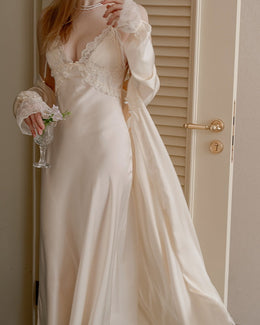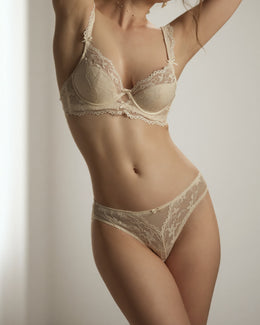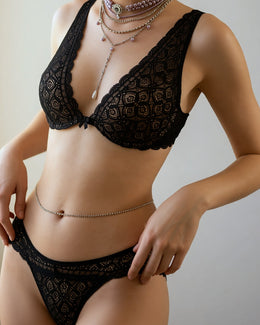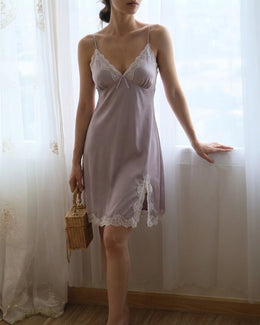



A bralette is a bra without rigid structure — no underwire, usually no padding, often no hooks. A bra builds shape around you; a bralette follows the shape you have. For A–C cups, a well-cut bralette can be a full-time choice. For fuller busts, it's a beautiful part-time one. The real question isn't which is better — it's which hours of your day each one owns.
What actually separates a bralette from a bra?
| Bralette | Structured bra | |
|---|---|---|
| Support comes from | Fabric tension and the underband | Underwire or soft-wire + engineered cups |
| Shape it gives | Yours, softened | Lifted, rounded, directed |
| Sizing | Usually S/M/L | Band + cup (32B, 34C…) |
| Under a fitted tee | Soft outline, sometimes visible texture if lace | Smooth, defined |
| Hours you forget it | Most of them | Depends entirely on the fit |
| Lifespan | Shorter — elastic does all the work | Longer if rotated and hand-washed |
When a bralette is enough
Support is mostly a band story: around 80% of hold comes from the underband, not the straps or wire. If you're an A–C cup, a bralette with a firm, wide underband does the same daily job as a wired bra — minus the hardware. Work-from-home days, low-impact everything, layering under knits, and any outfit where a triangle of lace at the neckline is the point, not an accident. That last one is half of why bralettes exist: they're made to be glimpsed. Ours are cut so the pretty part sits exactly where a shirt opens.
When you'll want structure instead
Three honest cases. D+ cups on long days — fabric tension alone asks the shoulders to do the band's job, and by evening you'll feel where. Under sharp tailoring — a blazer sits differently over a directed shape, and if you want that line, wire (or a good soft-wire) draws it. And high-movement days, where a bralette's freedom becomes bounce. None of this is a verdict against lace; our soft-wire vs underwire guide covers the middle path — wire that bends with you instead of caging.
The wardrobe answer: it's a rotation, not a choice
The women we make lingerie for don't own one bra; they own a small cast. A structured set for the days that need a line. A bralette for the days that don't. A silk set for the evenings that belong to the mirror. If you're starting the rotation from scratch, a matching set does double duty — the bralette wears alone, the set wears as a statement. Sizing note: bralettes in S/M/L forgive between-sizes bodies; if you're between, size for the underband, not the cup — snug band, breathing room above.
FAQ
Can a bralette replace a bra completely?
For A–C cups and everyday wear, yes — choose one with a firm, wide underband. For D+ or high-movement days, keep one structured bra in the rotation.
Do bralettes give any lift?
A little, from fabric tension — think gentle gathering, not push-up. If lift is the goal, that's a structured cup's job.
What size bralette should I buy if I'm between sizes?
Size for the band. A snug underband is where support lives; a slightly relaxed cup is comfortable, a loose band is pointless.
How long does a bralette last?
With hand washing and flat drying, one to two years of regular wear before the elastic softens. Machine washing and dryers cut that in half. Care details are in our lace washing guide.