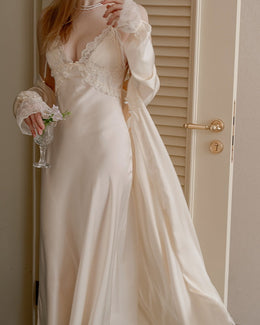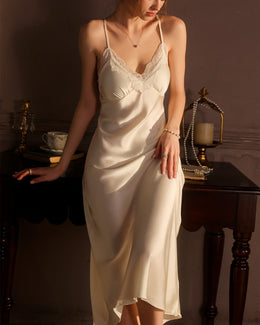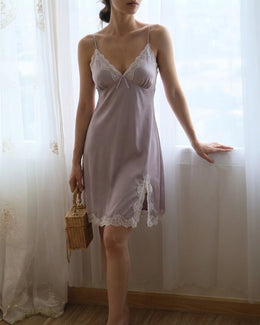



A silk slip fits when it skims without clinging: straps stay put without digging, the neckline lies flat against the sternum, and the fabric follows your line with a hand's width of ease at the hip. Bias-cut slips hug more and stretch diagonally — order your usual size, never down. Straight-cut slips hang looser and forgive more. The cut decides the rules.
Slips are easy to size wrong: people order them like T-shirts, and they are cut like neither T-shirts nor dresses. Five minutes here saves the exchange.
First, Know Which Cut You Are Buying
Silk slips come in two constructions, and they fit like different garments. A straight (on-grain) cut hangs from the shoulders and falls in a clean A-line — like our Plain English slip: round neck, thin adjustable straps, cut as plainly as a slip can be cut. It touches you at the shoulder and bust, and the rest is drape. A bias cut is sliced at 45° to the fabric grain, which gives non-stretch silk a diagonal give — our Curtain Call is cut this way, so it moves around you instead of with you. Bias hugs the waist and hip, pools slightly at every curve, and reads far more fitted at the same measurements.
The Fit Checklist, Point by Point
| Checkpoint | Right | Wrong — and what it means |
|---|---|---|
| Straps | Stay up through a shoulder roll, no marks by morning | Sliding: too long or neckline too wide. Digging: size up or loosen |
| Neckline | Lies flat on the sternum | Gaping forward: cup space exceeds you — size down or try straight cut. Pulling flat: too small |
| Bust seam / lace join | Sits at the underbust line | Riding above or below: torso length mismatch, check the length chart |
| Hip | A hand's width of ease; fabric skims | Clinging and creasing horizontally: too small. Tenting side seams: too large |
| Walking | Moves with the leg, falls back into line | Riding up with each step: too tight at hip (commonest bias-cut error) |
The Bias-Cut Sizing Rule (Where Most Returns Happen)
Here is the pattern behind most slip exchanges, and it is worth memorizing: people see "stretchy" and size down, the way they would with knitwear. Bias give is not knit stretch. It is diagonal, it is modest, and it recovers by pulling the fabric flat against the nearest curve — so a size-down bias slip does not "fit snugger," it clings and creases and rides. Order your true size in bias; when between sizes, take the larger and let the cut do the shaping. With a straight cut you may size down for a closer line, because the fabric hangs instead of wrapping. One cut rewards ambition; the other punishes it.
Length, Weight, and the Numbers on the Page
Silk weight changes how a fit reads. Sixteen momme floats and forgives; nineteen momme — the weight where silk stops floating and starts falling — hangs closer and shows the line of what is beneath it. Our Real Thing slip in nineteen momme carries a 148 cm hem sweep and a drawstring at the waist, which means the fit is adjustable at exactly the point bias cuts are opinionated. Details like hem sweep, hem finish (a 0.3 cm rolled hem rolls with curves rather than cutting across them), and strap adjustability are listed on each product page — they are fit information, not decoration.
Length is preference wearing a ruler: mid-thigh reads lingerie, knee reads slip dress, midi reads outerwear-adjacent. If you plan to wear it out of the bedroom, check the stated length against a dress you already trust — and see how to style a slip dress for where each length lands.
FAQ
Should I size up or down in a silk slip?
Bias-cut: true size, or up when between sizes — never down. Straight-cut: true size, or down one for a closer line. The cut, not the fabric, sets the rule.
Why does my silk slip cling to my hips?
Either the size is too small at the hip (look for horizontal creases) or static is at work. Fit clinging survives a fresh wash; static clinging disappears with a spritz of water or a run of a damp palm down the fabric.
How do I know if a slip is too small?
Three tells: horizontal pull lines at bust or hip, the hem riding up as you walk, and seams sitting forward or back of your side line. Any one means the next size, or the straighter cut.
Do silk slips shrink after washing?
Cold-washed and air-dried, silk holds its size. Heat is the shrinker — hot water or a dryer can take real length out of a slip and roughen the face. Our silk washing guide covers the safe routine.
Both cuts, all lengths, live in the silk collection — each page states cut, momme, and measurements, because a slip should be chosen the way it was made: precisely.