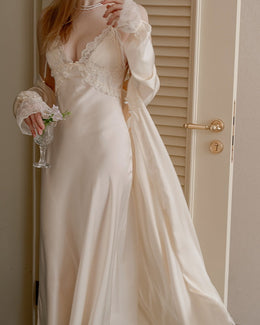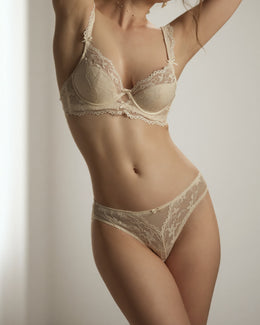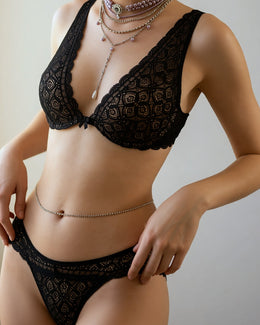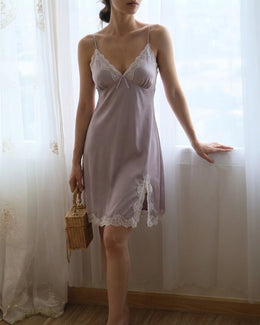



"French lace" properly means lace in the French tradition — Leavers, Chantilly, Calais-style — made on slow machines that knot fine threads into patterns with depth you can feel. "Regular lace" on most labels means raschel-knit lace: faster, stretchier, flatter, far cheaper. The difference is real and visible — but the phrase gets borrowed so often that the words alone guarantee nothing. Here's what you're actually paying for, and how to check.
What makes lace "French"?
Three names carry the tradition. Leavers lace — made on 19th-century looms (many still running around Calais) that twist thousands of individual threads; the pattern is part of the structure, not printed on it. Chantilly — a Leavers style known for fine floral detail on sheer net ground, outlined in silky cordonnet. Calais lace — a protected French designation for Leavers lace from that region. What they share: fine gauge, pattern depth, delicate scalloped edges, and cost — the machines are slow, the skills are scarce. True Leavers has little stretch; it's engineered into garments with elastic panels rather than stretching itself.
What's usually behind "lace" with no adjective
Raschel and tricot knitting machines produce lace-patterned fabric hundreds of times faster, usually with spandex knitted in. The honest version of this fabric is a good material: stretchy, resilient, comfortable, machine-tolerant. The dishonest version is the same fabric wearing the phrase "French lace" because the pattern looks vaguely floral. A century of French lacemaking has no trademark police on the word itself — so the label borrows freely.
Side by side
| French-tradition lace (Leavers/Chantilly) | Raschel-knit lace | |
|---|---|---|
| Made by | Twisting threads — pattern is structural | Knitting loops — pattern sits on the surface |
| Hand feel | Textured relief; you can trace the pattern blind | Flat, uniform, slightly slick |
| Stretch | Minimal — needs engineered fit | High — stretch is built in |
| Edge | Fine scallops, often with eyelash fringe | Cleaner, blunter, often cut-and-sealed |
| Under light | Varied density, sheer ground, sharp motifs | Even density, motifs blur at close range |
| Care | Hand wash, flat dry, no dryer, ever | Forgiving on gentle cycle |
| Cost driver | Slow machines + skilled labour | Speed — the point of the process |
The three-second checks that don't need a label
The fingertip test: close your eyes and trace the pattern. Raised, dimensional motifs point to the French tradition; a smooth surface where the pattern is only visual points to knit lace. The light test: hold it to a window — Leavers-style lace shows crisp motifs floating on genuinely sheer net; knit lace reads as one even texture. The stretch test: pull gently on the bias. Significant give means spandex knit (fine, just priced differently); a firm, barely-yielding hand suggests twisted construction. Where we use lace with stretch for fit — and we do, deliberately, where a bra needs to move — we say which is which, because the woman paying for lace deserves to know which lace.
One more honest note: French-style lace can itch cheap skin-side finishing regardless of pedigree. If lace and your skin have history, the fix is in the finishing and lining, not the country — that guide is here.
FAQ
Is French lace always made in France?
No. "French lace" describes the technique and style; Leavers-type lace is also made in a few mills elsewhere. "Dentelle de Calais-Caudry" is the protected label that guarantees French origin on Leavers looms.
Is French lace worth the extra cost?
For pieces meant to be seen and kept — yes, the depth and edge quality are visible across a room. For everyday stretch-lace basics that live in the wash rotation, good raschel lace is the more rational buy.
Why does my lace bra have mesh panels?
Low-stretch lace can't provide fit on its own, so designers pair it with stretch mesh or elastic frames. Panels are a sign the lace is being engineered around, which is usually a good sign about the lace.
How do I wash French-style lace?
Cold hand wash with a drop of gentle detergent, press dry in a towel, flat dry. No wringing, no dryer. Treat it like the textile equivalent of jewellery — full routine here.